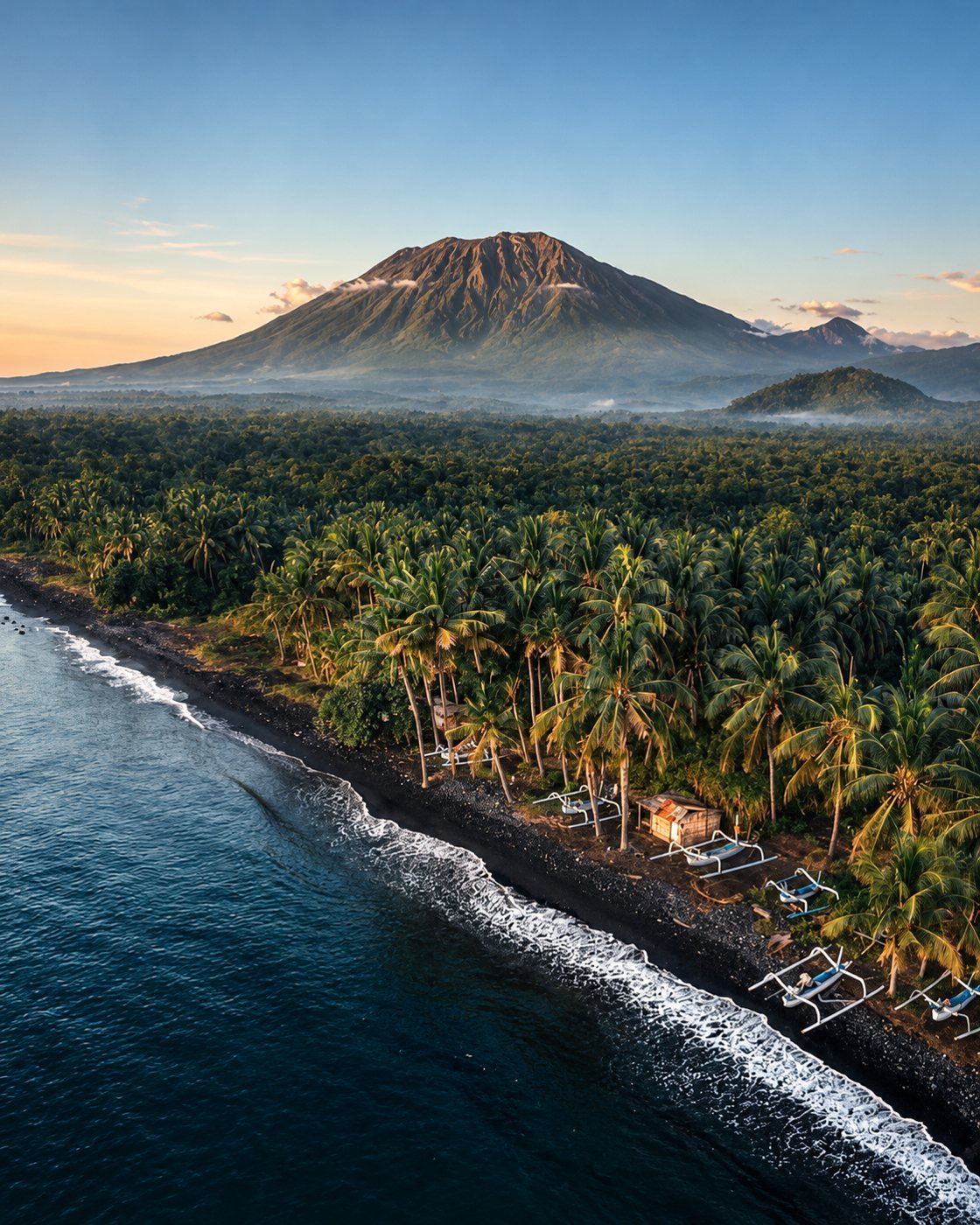
At 3,031 meters, Mount Agung is the highest point on Bali and the spiritual axis of the island. Balinese orient their homes, temples and even sleeping positions toward it, and Pura Besakih, the mother temple of Balinese Hinduism, sits high on its southwestern slope. On a clear morning the near-perfect cone is visible from much of the island, often wearing a collar of cloud by midday.
Agung is an active stratovolcano with a violent record. Its 1963 eruption was one of the most devastating in Indonesian history: pyroclastic flows and lahars killed well over a thousand people. Lava passed close to Besakih yet spared the mother temple, which many Balinese still regard as a sign from the gods. After decades of quiet, the mountain stirred again in 2017, forcing large evacuations and closing the airport, with further eruptions continuing into 2019.
Climbing Agung is a serious undertaking, usually begun around midnight with a licensed local guide. The Besakih route reaches the true summit; the shorter Pasar Agung route ends on the crater rim. Both are steep, loose and cold before dawn, and the reward is sunrise above the clouds, with the shadow of the mountain stretching west and Rinjani on Lombok rising to the east.
Highlights
- Sunrise from the summit above the clouds
- Views across to Mount Rinjani on Lombok
- Pura Besakih on the southwestern slope
- Pasar Agung route to the crater rim
Good to know
- Check the current alert level with MAGMA Indonesia (PVMBG) before planning; summit access can close at short notice.
- Hire a licensed local guide; climbing alone is strongly discouraged and often not permitted.
- The mountain may also close to climbers during major ceremonies at Besakih, so confirm dates with your guide.
- Bring warm layers, a headlamp and plenty of water; temperatures near the top drop sharply before dawn.
On the map

Bali 2027 Travel Guide
The complete island guide: where to go, how to get around, what to avoid, health and safety, and the phrases that open doors.